Active Projects
The PID lab has an active and diverse research agenda. The research thrusts below represent several ongoing studies that investigate collective human behavior, human-human interactions, human-machine interactions, and human-machine-human interactions.

Evaluating the impact of New Jersey’s Extreme Risk Protection Order law on firearm violence
Firearm violence remains a serious public health concern in New Jersey, with profound impacts on individuals, families, and communities. The state enacted its Extreme Risk Protection Order (ERPO) law in 2019, allowing family members and law enforcement to petition courts to temporarily remove firearms from individuals deemed to pose a risk to themselves or others. While ERPO laws have been adopted in multiple states, their effectiveness depends heavily on how they are implemented, and New Jersey’s law has not yet been rigorously evaluated.
This project uses causal inference methods to quantitatively assess the impact of New Jersey’s ERPO law on firearm-related homicides. Leveraging restricted-use mortality data from the Centers for Disease Control and Prevention (CDC), the study examines firearm homicides at the county and monthly level, with analyses stratified by gender, race and ethnicity, and geography. The goal is not only to determine whether the law reduced firearm violence overall, but also to understand who benefits most from it and where gaps may remain.
This project is supported by the New Jersey Health Foundation (Award PC30-26) .
Protecting Under the Hard Hat: A web-based tool to make mental health resources more accessible to the construction workforce
Firearm violence remains a serious public health concern in New Jersey, with profound impacts on individuals, families, and communities. The state enacted its Extreme Risk Protection Order (ERPO) law in 2019, allowing family members and law enforcement to petition courts to temporarily remove firearms from individuals deemed to pose a risk to themselves or others. While ERPO laws have been adopted in multiple states, their effectiveness depends heavily on how they are implemented, and New Jersey’s law has not yet been rigorously evaluated.
This project uses causal inference methods to quantitatively assess the impact of New Jersey’s ERPO law on firearm-related homicides. Leveraging restricted-use mortality data from the Centers for Disease Control and Prevention (CDC), the study examines firearm homicides at the county and monthly level, with analyses stratified by gender, race and ethnicity, and geography. The goal is not only to determine whether the law reduced firearm violence overall, but also to understand who benefits most from it and where gaps may remain.

Social Telerehabilitation
In telerehabilitation, patients perform physical therapy using electronic devices that measure their movement. Data from the devices is then sent to clinicians for remote assessment of their recovery. However, in the absence of a therapist, patients do not perform their prescribed therapy. This lack of adherence significantly hinders their recovery. Social interactions where patients exercise together online could motivate them to perform their exercises regularly. Beyond facilitating their recovery, online social interactions could provide patients a community to identify with and alleviate feelings of depression and isolation that people with injury and disease commonly experience.
In this project, we design and analyze interfaces for rehabilitation that capitalize on social interactions to promote patients’ adherence, recovery, and well-being. We focus on several populations including stroke patients, injured construction workers, and individuals with visual impairments.
Smart and Engaging Interfaces
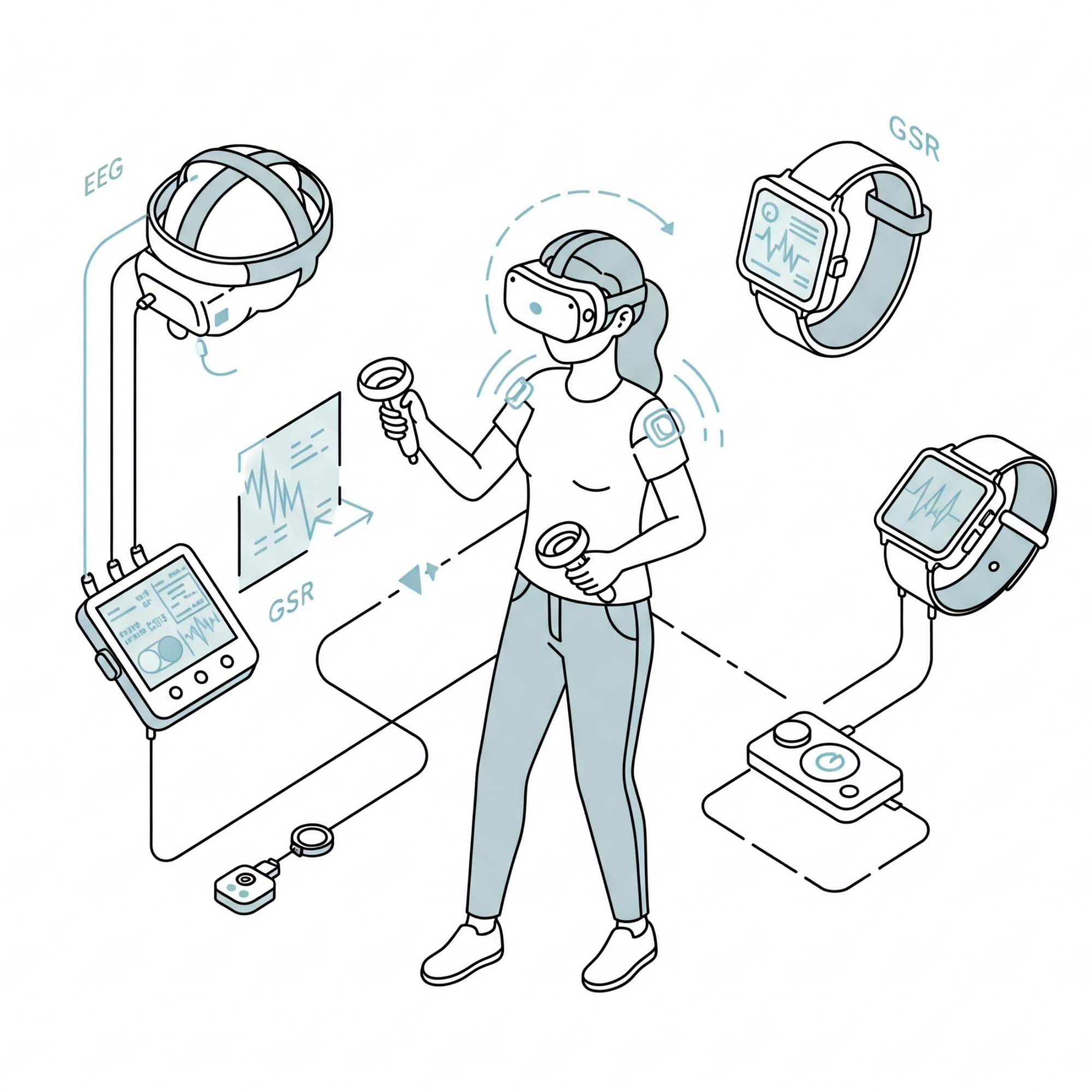
People increasingly use technological interfaces, whether it is for work, education, health, or entertainment. To maximize human engagement and performance, smart interfaces that “know” what actions people are carrying out, “infer” their affective state, and “respond” to them could be devised. For example, telerehabilitation interfaces could automatically assess patients’ movements and provide feedback on their motor performance in real time to enhance their motivation.
In this project, we relate physiological and behavioral measurements from gaming systems and wearable devices to measurements of people’s affect, engagement, and satisfaction from brain-computer interfaces. We integrate these relationships into econometric forecasting models and natural language processing algorithms to enable dynamic feedback systems.